Sunday, May 19, 2013
Similarites & Differents between Kotharam/Gothara & Kula Deivam ?


Thursday, November 22, 2012
How to observe Vratam Veratham for Sabarimala Ayyappa Temple
.jpg)
The Vratham or Vrata for visiting Sabarimala Ayyappa Sannidhanam or Swamy Ayyappa Temple starts on the first day of the Malayalam month of Vrichikam (this year on 17th November 2010) and culminates on Mandala Pooja Day (27th December 2010) or Makara Sankranti day (14th January 2011). On observing this Sabarimala Vratham (austerities), the mind and soul get purified as the devotees undertake certain practices and cleanliness. Here are some of the customs and rules of the austerities. For those who cannot start vrata on the first day of Vrishchika can start on any other day.

Maladharanam – Wearing of Mudhra Mala
The Sabarimala Ayyappa Vratha is marked by the wearing of "Thulasi Mala" (garland) or "Rudraksha Mala”, bearing the locket of Lord Ayyappa of Sabarimala Temple. The temple priest or Guru Swami / Periya Swami instigates the Mudra Mala to the devotee (Maaladharanam), by chanting mantra or simply “Swamy Saranam”. Guru Swamy or Periya Swamy is an Ayyappan devotee who has completed 18 successive years of Sabarimala pilgrimage and he guides others for the pilgrimage. The garland is to be obtained after sanctification in a temple / pooja room. Devotees offer "Dakshina" to the concerned priest. Subsequent to this ritual, the devotee wearing the "Mala" is called as "Ayyappan" or "Swamy" and the female (aged between 1 and 9 OR above 50 years) devotees are called as "Malikapuram" (who is the Shakti of Lord Ayyappa).

Mantra for wearing Mudhra Mala Dharan can be found here
Below are the austerities and rules that are to be followed for taking the Ayyappa Sannidhanam pilgrimage
1) On the day before starting the vratham, the devotee has to shave, trim his nails and hair and make himself clean. The Thulasi Mala or Rudraksha Pendants should be cleaned and smeared with sandal paste and placed before the image of Lord Ayyappa. Only a new pair of colored (black, blue and saffron) dhoti and towel/shawl is to be used by the devotee.
2) During the Sabarimala Vratam, the devotee should wake up early in the morning, offer prayers and perform pooja to the holy mala. Also, he should not apply oil to his hair and shall not make oil smeared over his body.
3) The devotee of Ayyappa Swami shall not take part in any of the social activities. He shall spend his time only by prayers, poojas, visiting temples and helping the poor/needy.
4) The devotee should consume only satvic foods (vegetarian diet) and abstain from non-vegetarian, alcoholic drinks or drugs, chewing betel leaves and from smoking.
5) Taking bath twice/thrice daily and performing puja by chanting 108 Ayyappan Saranams form part of the austerity. Apart from Ayyappa Saranams, devotees can chant Ayyappa Gayatri Mantra, Ayyappa Ashtottara Stotram, Loka Veeram Mahapoojyam Ayyappa Namaskara Sloka or any other mantras and prayers of Lord Ayyappa.

6) He should not hurt anybody either verbally or physically, and consider all co-devotees as Lord Ayyappan himself.
7) The Swami should not feel proud for the respect he gets during his observance for the pilgrimage.
8) The devotee should not in any way cause trouble to his family members because of his vratham.
9) He should practice pure Brahmacharya (celibacy) in his deeds, words and thoughts, during the pilgrimage period. Only vegetarian food and fresh fruits are to be consumed. He should sleep only on the floor, avoiding pillows. Some devotees do not use footwear so as to make their feet adjusted to climb the Sabarimala hills barefooted.
10) The Swami shall avoid himself from the proximity of dead body. If he happens to see one, he shall not eat anything until he takes bath.
11) It is always better to carry a Thulasi leaf to prevent him from evil spirits and from impurities.
It should be remembered that the blessings of Lord Ayyappa would reflect on those who strictly follow these rules.

Swamiye Saranam Ayyappa!!
Harihara sudhane Saranam Ayyappa!!

Monday, October 15, 2012
Real Story Shiva Lingam


Some idiots translate "Linga" as penis which is Wrong and this myth is spread by missionaries and muslims
The Linga has different meanings - shapeless, without organs, long drum like, etc
penis is called linga by some people due to its shape...the actual world for penis is "Shishna" in sanskrit
Shiva Linga here means, Shiva without form... it is like when we die our soul is called "Linga Sharira"
Shiva being worshipped as Linga means the Consciousness in its primodal form...where Consciousness is entering into the Eternal Energy (Shakti).
Thus shivalinga is the state of god, just before the manifestation of Universe, a little before bag bang.
Shiva is worshipped as Linga...because that is the highest of all manifested gods, formless, attributeless.... simple Consciousness and Energy (shiva and shakti)
---------------------------------------- XXXXXXXXXXXX------------------------------------------------------XXXXXXXXX------------------
Linga means "sign, mark, or symbol". It also refers to a digging implement or plough. Since the plough readies the earth for insemination, the word linga is also applied to the phallus, particularly as the phallic emblem of Shiva. Though Shiva is considered the destroyer (Trimurti) according to Hindu belief, creation (Srishti) follows destruction. The linga is therefore associated with the sexual union of Shiva and Parvati, which results in creation. It is a symbol of the procreative power of the universe.
Linga is derived from the Sanskrit word lingam, which comes from li meaning, "to dissolve" and gam "to move on". This refers to the belief that one appears as a being in the world and then dissolves back into the universe.
A Shivalinga is phallus-shaped and fixed on a base, which is shaped like a yoni. The structure symbolises the supreme creative energy. It is usually made of stone but can also be of wood, metal, crystal, and soapstone.
There are various explanations as to why the linga represents Shiva. According to the Vamana Purana, after Sati's death, Shiva went to mourn in the forest. Seeing the virile god, the wives of the sages living in the forest were enamoured and followed Shiva around. Enraged, the sages cursed Shiva, causing his phallus to fall off. The moment it touched the ground, his phallus started growing. Soon the earth, unable to support its weight, began quivering. When Brahma and Vishnu realised why the earth was shaking, they requested Shiva to take back his phallus. Shiva consented to do so on the condition that the sages worshipped his phallus. He pronounced that nothing would be impossible for one who worshipped the Shivalinga.
The Linga Purana says that Brahma and Vishnu were once arguing over who was the supreme being. Suddenly, there appeared Sivalinga before them a huge column of fire. Both of them decided to find one end each. Whoever returned first would be acknowledged as supreme. Vishnu assumed the form of a boar and dug into the earth. Brahma, in the form of a swan, flew upwards. They searched for days but in vain. Then Shiva appeared in the fiery column. Brahma and Vishnu realised their mistake and acknowledged Shiva as the Supreme Being. The Shivalinga represents that column of fire Jyotirlinga
The phallic cult appears to have been prevalent in India since the Indus Valley Civilisation (c. 3000 BC - 700 BC). Emblems resembling the linga and yoni have been discovered in excavations of ancient cities. Although the Vedas are contemptuous of the linga because of its association with the phallus, later literature like the Puranas and tantric texts laud phallic worship. According to these texts, Brahma, Vishnu and other gods live at the site where Shiva exists in the form of a linga. The Vamana Purana says that during Chaturmasya, Shiva sleeps in all lingas. Therefore, praying at any linga during this time is considered especially auspicious. It is believed that the land within 100 cubits (about 160 ft) of a linga is very sacred and called Shivasthala.
There are approximately 30 million lingas in temples and shrines all over India. Most of them are named after the place where they are located or after the person who established them there. Lingas fall into three categories. The first are the Anadi or Svayambhu, or self-generated lingas. They are believed to be the most sacred and are said to have fallen from heaven. Next are the Sithavara, or fixed lingas. These are crafted and then, after an initiation ceremony done according to Puranic rites, installed at a sacred location. It is believed that once a linga is installed, it should never be moved as that would result in a calamity. The third category of lingas are the Jangam, or movable lingas. These are the miniature lingas, which are made of stone, clay, metal, or other material. They are worn as amulets and necklaces, or worshipped in the homes of Shiva's devotees.
The actual worship of the Shivalinga begins with bathing it, first with water mixed with earth, and then with water mixed with the Panchagavya. The linga is then smeared with sandalwood paste. Next, flowers and leaves are offered especially bel leaves. Next comes the arati, followed by the devotee's prayer. Shiva is believed to be very hot-tempered: bathing the linga and applying sandalwood paste are believed to soothe him.
------------------------------
Shiva Linga is a wide spread Indian Phallic figure. It consists of a feminine base ‘Yoni’ or ‘vagina’ and a rising masculine portion ‘the Phallus’ or ‘penis.’ The Linga artifacts, dating from the first century BC to the third century AD, are shaped like realistic ‘Phalli’. Thereafter the shape becomes progressively more abstract. By medieval times, its observable portion, rising from the Yoni, forms a round block with domed apex.
Shiva, the lord of erect Phallus (urdhvalinga), is traced to the ithyphallic figure of Indus Valley civilization or to the phallic images found more generally in prehistoric India. The epics and Puranas tell how a great fire appeared from the cosmic waters, and from this flame Linga Shiva emerged to claim supremacy and worship over Brahma and Vishnu, when he was castrated because he seduced sages’ wives in the pine forests of Himalayas. He castrated himself because no one could castrate the Supreme Lord. Thus fallen phallus of the Supreme Lord destroyed all the worlds until it reached the Yoni of Uma/Parvati and cooled down. All procreation of worlds started after the worship of Yoni-Linga was restored and all Gods, including Vishnu and Brahma accepted supremacy of Lord Shiva.
Lord Shiva’s other form is ‘Ardhanariswara’, half man and half woman. Lord Shiva, with his consort Parvati, is always in a celestial dance of procreation and destruction of the worlds. He is not only the embodiment of ‘Kama’ (the sexual lust, desire or pleasure, the force that is the basis for the evolution of diverse life forms and Humans on earth) in the forms of Phallus and androgynous Ardhanarishwara, but also the destroyer of ‘Kama’ when he destroyed ‘Kamadeva’ only to restore his life at the request of Kama’s wife Rati, ‘the coitus or the sexual intercourse.’ Without the sexual desire (Kama) there is no sexual intercourse (Rati) and no procreation. Lord Shiva’s manifestations are memorialized in the local texts of great shrines ranging from temple complexes of Khajuraho in the north to Madhurai in the south.
Shiva mythology, in fact, is a rich source of Indian thinking about sexuality, social relations, ritual, cosmic process, and metaphysics. The Male-Female union in the form of “Phallus or Shiva Linga or Yoni-Linga” or “the Ardhanarishwara” may be visualized as a parallel to the Chinese philosophy of “Yin-Yang” or ‘the Male-Female.” Metaphysically, it also is the most scientific philosophy that explains fundamentals of existence through ‘positive and negative’ or ‘male and female’ aspects of matter and life. Moksha is only after Kama, of the four principles of life-Dharma, Ardha, Kama, and Moksha. Kama is a sacred duty of men and women.
Unfortunately, some of us are ashamed of it because of Christian and Islamic influences. It was unacceptable, shameful and sinful to the Christians. They denounced it without understanding the culture, wrote demeaning articles, made laws and were able to influence the population to some extent. Their purpose was to teach us (the cultures which consider sex as sacred) the true path to God, the Christianity that considers sex as sin and purification of which is attained only by the blood of Jesus, the savior. Victorian Christians had the same kind of shock when they colonized Polynesian islands, for those islanders were sexually explicit in their lifestyle. The shocked Christian missionaries vowed and succeeded to eradicate the satanic culture by converting them to Christianity!
Fortunately, in the Indian continent non-Christians and non-Muslims still survive and continue age-old practices of respect for nature, animals and recognize the sacred aspect of sex. That is why we are considered an old and continuing civilization without any break, while our brethren in Europe lost their religion and culture totally to Christianity. The Indian reformers, with the British influence and help, got rid of some oppressive customs like Devdasi, Basivi, Sati etc., that forced women into prostitution and self-immolation in the name of religion. Ironically, today the Indian society looks down upon the west as a promiscuous society, and attempts to protect itself from the western vulgarity, indiscrimination and extramarital sex by censorship, a legacy of puritanical Christian and Islamic influence, while maintaining the sacred sensuality in the religion and within the marriage.
lord shiva linga story


 There are twelve important Jyotirlinga temples scattered across India. They are found in Kedarnatha, Kashi Visvanatha, Somnatha, Baijnath, Ramesvare, Ghrisnesvar, Bhimasankar, Mahakala, Mallikarjuna, Amalesvar, Nagesvar, and Tryambakesvar. The five Pancha Bhuta Lingas in India are located at Kalahastisvar, Jambukesvar, Arunachalesvar, Ekambesvara at Kanchipuram, and Nataraja at Chidambaram. The temple of Lord Mahalinga at Tiruvidaimarudur (Madhyarjuna) is also a great temple in South India.
What is Shiva Lingam?
Shiva Linga: The Symbol for Shiva
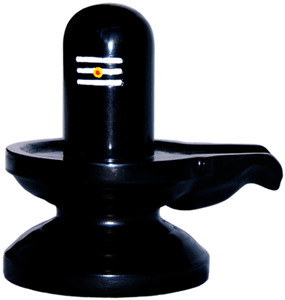
The Linga as a Symbol of Creation
The 3 Parts of a Shiva Linga
The Holiest Shiva Lingas of India
The Quartz Shiva Linga
What the Linga Means to Devotees
Sunday, April 17, 2011
Pazhamudircholai Temple
Click Here --> Arupadaiveedu Home Page

Pazhamudircholai is a Hindu temple located 13 miles north of Madurai, India atop a hill covered with dense forests. One of the six important abodes Arupadaiveedu of Lord Muruga, it is very close to the Vishnu temple of Azhagar Kovil. One can reach Pazhamudircholai by car, van, two-wheeler or bus, from madurai one can catch the bus (Bus No: 44) to reach Pazhamudircholai. There is a bus shuttle for every 20 minutes from the foot of the hill to the Temple. It takes approximately 15 minutes to reach the temple.
Pazhamudircholai is rich in fruits, vegetables and flowers. It is a dense forest where Valli is supposed to have lived. It is a small temple with Valli, Deivayanai, and Lord Muruga in a separate shrine. Lord Ganesha is also present in a separate shrine. There is a Temple Tower and monkeys play around the area. There is another small temple above Pazhamudhir Cholai. Local tribes lead their lives here. It is a fertile hill with many natural springs and herbs.
Although there are hundreds of Temples in Tamilnadu for Lord Muruga, particularly six temples called "Arupadaiveedu" are very famous among them. Important events in Lord Muruga's history happened in these places. Among the Arupadaiveedu (Six Temples), Pazhamudircholai is the last Padaiveedu. This Pazhamudircholai Lord Murugan is praised in old Tamil literature such as Silappathikaram, Ettuthokai, Pattupattu etc. The great Tamil poet and saint Avvaiyar had been tested by Lord Murga here.

In order to play with Avvaiyar who was one of the very famous devotees of Lord Muruga, the Lord played a drama. One day Avvaiyar became tired while travelling because of very hot summer and so came under the shadow of a fruit tree. She was very hungry and thirsty. At that time, a small boy who was sitting on the tree asked her whether she wanted fruits from the tree. Avvaiyar told that she wanted fruits. At that time the boy asked Avvaiyar whether she wanted roasted fruits or unroasted fruits. Avvaiyar who was a famous Tamil poet, litterateur and having indepth knowledge in Tamil thought,"Is there any roasted fruit in the world?" and decided that the small boy didn't have knowledge even about a fruit.

But, as she was very tired, she didn't want to argue with the small boy and asked him to pick roasted fruits for her. The boy shook the tree and so fruits fell under the tree. The mud under the tree had stuck on the fruit. Avvaiyar took the fruits and blew on the fruit to remove the mud. It was observed that as the fruits were roasted and had become warm, Avvaiyar had blown the fruits to cool them. At that time, the small boy asked Avvaiyar whether the fruits were warm? Avvaiyar was astonished, "How had a small village cowboy played such an intelligent drama? She had thought that the small boy had no knowledge about fruits and how the fruits in the tree may become roasted fruits. But blowing the air on the fruit to remove the mud is like blowing air to reduce the heat as the fruit is roasted. What a beautiful comparison.

Such a beautiful comparison would not have risen in her mind even though she had gained rich knowledge in Tamil." She asked the small boy, "Who are you actually?" At ,the small boy disappeared and in his place, Lord Muruga appeared. Now Avvaiyar realized that it was a play of God and she understood that there were more and more things that she had to learn. She bowed to Lord Muruga and requested him to bestow her with bountiful knowledge.

Tiruthani Murugan temple

Tiruthani Murugan temple is a Hindu temple, in the hill of Thiruttani, South India, dedicated to Lord Muruga. The hill has 365 steps indicating 365 days of the year.It is one of the Arupadaiveedu, the six holy abodes of Lord Muruga. The other five are: Palani (100 km west of Madurai), Swamimalai (150 km east of Madurai), Tirupparangunram (5 km from Madurai), Pazhamudircholai (10 km north of Madurai) and Thiruchendur (100 km south of Madurai).

History
The origins of this temple, like most Hindu temples, are buried in antiquity. This temple has been mentioned in the Sangam period work Tirumurugaatruppadai composed by Nakkeerar. It has been patronized by the Vijayanagar rulers and local chieftains and zamindars.
Mythology
Legend also has it that Indra the king of the Gods gave his daughter Deivayanai in marriage to Skanda, and along with her presented his elephant Airavatam as part of his dowry offering. Upon Airavatam's departure Indra found his wealth waning. Subramanyar is said to have offered to return the white elephant, however Indra bound by protocol refused to accept a gift that he had made, and insisted that the elephant face his direction, hence the image of the elephant in this temple also faces the east.

Another legend has it that Indra presented a sandal stone as a part of his daughters dowry. The sandal paste made on this stone is applied to the image of Subramanya and the applied paste is said to acquire medicinal value. Legend also has it that Skanda bore the discus thrown by the demon Tarakasuran on his chest, and hence there is a hollow in the chest region of the image of Subramanya in this temple. Legend also has it that Skanda gifted the discus to Vishnu (Please also see Tiruveezhimizhalai and Tirumalper). Skanda is also believed to have imparted knowledge of Tamil to the sage Agasthyar and he is regarded as Veeramurthy, Gnanamurthy and Acharyamurthy in this shrine.
Lord Rama, after putting an end to Ravana, worshipped Lord Siva at Rameswaram and then came to Tiruttani to find perfect peace of mind by worshipping Lord Subrahmanya here. In Dwapara Yuga, Arjuna got the blessings of our Lord here by offering prayers to Him on his way to the South for Teertha Yatra (pilgrimage to take sacred immersion). Lord Vishnu prayed to the Lord and got back His powerful Chakra (sacred wheel), Shanku (sacred conch), which were forcibly seized from Him by Tarakasura, brother of Soorapadma. Lord Brahma propitiated the Lord here at the holy spring known as Brahmasonai after his imprisonment by our Lord for his failure to explain the Pranava ('Om' mantra) and got back his creative function of which he was deprived by our Lord due to his egotistic impudence in neglecting to worship Lord Subrahmanya on his way to Mount Kailasa to worship Lord Siva. The final steps to the eastern entrance.
On worshipping our Lord at Thanikai, the king of snakes Vasuki got his bodily wounds healed, which had been caused during the churning process in the Milky Ocean to secure the Amrita (nectar of immortality) by the devas and asuras when the Mantotra Mountain was used as the churning base and the snake king Vasuki as the rope. Sage Agasthyar Muni (of Potikai Hill) worshipped Lord Muruga at Tanikai when he was blessed with the divine gift of the Tamil language.

Significance of the temple
Apart from its puranic greatness, Saint Arunagirinathar has praised this hill as the chosen place for worship by devas and the favorite abode of saints performing prolonged tapas. He also compared this hill to Sivaloka (Bhuloka) and as the very soul of the world. Sri Muttuswami Deekshitar, who lived 200 years ago (one of the trinity of Karnatic music) had his inspiration in Tiruttani when the Lord (in the guise of an old man) met him on the steps and sweetened his tongue with the prasadam of this temple, which impelled him to sing his first song on Lord Murugan of Tanikai.The temple vimanam was covered by gold
--------------------------------------------------
This temple is located in the township of Tiruttani 50 km north of Chennai en route to Tirupathi. According to Hindu mythology, Lord Murugan married Valli, the daughter of a hunting tribe cheiftain, here. Murugan is the parihara for all Rahu doshas. Offer worship at this ancient shrine of Lord Murugan and receive his divine grace in abundance.

Swamimalai Temple
Click Here -> Arupadaiveedu Home Page

Swamimalai Murugan Temple is a Hindu temple located in the township of Swamimalai, 5 km from Kumbakonam on the banks of a tributary of river Cauvery, 250 km from Chennai and is near to Thanjavur in India.
It is one of the Arupadaiveedu, believed to be the six main abodes of Muruga. According to Hindu belief, Swamimalai is where Muruga preached what as called as "Pranava mantra" to his own father, Shiva, at a tender age, after arresting 'Brahma' for not answering his question about Pranava Mantra. Though this temple is considered as one of the Arupadaiveedu of Lord Muruga, the real Padaiveedu lies at a place called 'Thiruveragam', from where the Lord Muruga idol is brought during the 'Soorasamharam' festival.

In Swamimalai, Lord Muruga is known as "Balamurugan" and "Swaminatha Swami". The speciality of the temple is that it has been built on an artificial hill. In Tamil language, such an artificial hill is called "Kattu Malai". The next important feature is the steps of this small artificial hill. There are 60 steps and each is named in one Tamil year. There are a total number of 60 Tamil years and hence the 60 steps. Another name for this place is "Thiruveragam".
The history of the temple known as "Sthala Puranam" is as follows: Once, Lord Brahma, the creator of living beings, had disrespected Lord Muruga (the son of Lord Shiva) at the time of visiting Mount Kailash where Lord Shiva resides. Hence Lord Muruga got angry with Lord Brahma and asked him how he was creating living beings such as people, animals etc. Lord Brahma said that he was creating living beings with the help of the Vedas (The Holy Hinduism Books). On hearing the reply, Lord Muruga asked Lord Brahma to recite the slogans from such Vedas. Brahma started to recite the slogans with the Holy word called Pranav Mantra "Om". At that time Lord Muruga stopped Lord Brahma and asked him to tell the meaning of the holy word "Om". Lord Brahma couldn't tell the meaning and hence Lord Muruga punished him with imprisonment. With Brahma imprisoned, all creations came to a standstill and the devas prayed to Lord Siva to get Brahma released.

Lord Shiva came to Lord Muruga and asked him to release Lord Brahma from imprisonment. Lord Muruga refused to release him on the grounds, that Lord Brahma was not suitable to do the work, as he did not known the meaning of the Pranav Mantra(Hindi: ॐ AUM).So Lord Shiva asked Lord Muruga whether he knew the meaning himself and to tell the meaning to him. Lord Muruga told Lord Shiva that he was ready to tell but levied one condition that, even though Lord Shiva who is his father should hear the meaning by giving full respect to him, like the respect given by a student to his master at the time of learning. Lord Shiva accepted the request and heard the meaning of the Pranav Mantra (Hindi: ॐ ) like a student from his beloved son.
This important and interesting incident happened in Swamimalai and hence Lord Muruga is known as "Swaminatha Swami". The meaning of this name is "The Teacher of Lord Shiva". The Lord Muruga idol is 6 feet in height. There are Gold coverings, Gold crown and a Diamond Vel for the Lord.
---------------------------------------------------

HISTORY OF THE TEMPLE: Swamimalai is fourth among the six padai veedu or sacred shrines dedicated to Lord Muruga. The presiding deity here expounded the meaning of the Pranava mantra OM to his own Father Lord Siva Himself.
Mythology says that saint Bhrugu before commencing an arduous tavam or penance, got the boon that anybody disturbing his mediation will forget all his knowledge. Such was the power of the penance that the sacred fire emanating from the head of the saint reached up to the heavens, and the frightened devas surrendered to Lord Siva praying for his grace. The Lord extinguished the sacred fire by covering the saint's head by hand.

With the saint's penance thus disturbed the Lord became oblivious of all his knowledge and is said to have regained them by learning the Pranava mantra from Lord Muruga at this shrine
Once when Brahma, the lord of all creations was proceeding to Kailasa, the ever-playful child Lord Muruga asked him for the meaning of the Pranava OM. When Brahma admitted his ignorance, the Lord imprisoned him. With Brahma imprisoned, all creations came to a standstill and the devas prayed to Lord Siva to get Brahma released.
When Muruga insisted that the imprisonment was a just punishment for the ignorance of Brahma, Lord Siva asked him whether he himself knew the meaning of the primordial Pranava OM. Lord Muruga said that he knew the meaning of OM and can expound it to the latter only if he can accept him as guru and listen to the exposition as a devoted disciple. As Lord Siva acceded to the request of Lord Muruga and heard the exposition of OM as a disciple, the place came to be known as Swamimalai and the presiding deity as Swaminathan.
DIVINESS OF THE TEMPLE: The temple is built on an artificial hillock of about sixty feet height with sixty beautifully laid stone steps representing the Hindu cycle of sixty years - leading to the Lord . In the ground floor there are temples dedicated to Lord Sundareswarer and Goddesss Meenakshi.
Hymns in praise of the presiding deity have been sung by saint Nakkeerar in Tirumurukatrupadai and by Saint Arunagirnathar in Tiruppukazh.
AUSPICIOUS DAYS: ADaily pujas to the deities are performed six times a day. The important festivals conducted in the temple are Monthly Kirutikai festival; Temple Car festival in April; Visakam festival in May; Navaratri festival in May; Skanda Shashti festival in October; Tiru Karthikai festival in Novv/December; Taippucam festival in January; and Pankuni Uttiram festival in March. 
POOJA TYPES AND TARIFF: Poojas listed here are applicable for this temple only.The tariff shown are not actual cost payable to the temple. It includes our service charge, cost of pooja items and Delivery charges.
---------------------------------------------------Palani Temple
Click Here --> Arupadaiveedu Home Page

History of Palani Murugan Temple

Palani Malai
‘Palani Murugan Temple’ is one of the most famous Murugan temples in India. It is located in the township of Palani, 100 km west of Madurai, and near the famous hill station, Kodaikanal.
It is one of the major Arupadaiveedu of Lord Muruga. The other Arupadiveedus are Tiruchendur (100 km south-west of Madurai), Swamimalai (150 km east of Madurai), Tiruttani (50 km from Chennai), Pazhamudircholai (10 km north of Madurai) and Tiruparamkunram (10 km south of Madurai).

The Legend of the Palani Temple
According to legend, Sage Narada once visited the divine court of Lord Shiva at Mount Kailash. Lord Shiva was with his consort, Goddess Shakti, and their two children, Lord Ganesha and Lord Subrahmanya. Sage Narada gave Lord Shiva a mango fruit and told him that it was a special fruit, the fruit of wisdom.
Lord Shiva wanted his children to have the fruit of wisdom. However, when he offered it to them, Sage Narada asked that the mango not to be cut in two to be shared between the two sons, lest the power be diminished. Now, as a result, they had to decide who should have it. Shiva and Shakti decided that the son who first circles the Earth would get the fruit. Immediately accepting the challenge, Lord Murugan, started his journey around the globe on his divine vehicle, the peacock or mayil.
Lord Ganesha, who believed that his parents were his world, circumambulated Lord Shiva and Goddess Shakti and claimed the mango fruit. Lord Subrahmanya returned to Mount Kailash, only to find that Lord Ganesha had already won the contest. Lord Murugan felt he had been deceived and decided to leave Mount Kailasam. He reached to top of what is today called “Pazhani malai” (the Hill of Pazhani) and set up his abode there.

Goddess Shakti and Lord Shiva rushed to the hill and tried to pacify their son, calling him, Gnana Pazham Nee appa (in Tamil, “you are the fruit – Pazham; of wisdom – Gnana”). Hence this place came to be called Pazhani, or Palani.
------------------------------------------------------------------------------

Palani is home to one of the most sacred shrines of the God Subrahmanyan, as worshipped in the Hindu cult of Koumaram. The Dhandayudhapani Temple dedicated to Lord Murugan, and regarded one of his Arupadai Veedu (Six Battle Camps), is situated here. The temple situated atop the Sivagiri is small but attracts a flood of devotees from all over the country. The architecture of the temple appears to be of the Pandya school. The Garbagriham is surmounted by a gold gopuram, most admirably worked. Steps are hewn into the rock, besides a wide path meant for the ascent of elephants, up the hill. In addition, a funicular railway with three tracks and a rope way have been provided more recently for the comfort of the pilgrims.
In keeping with the traditions of all temples of the God Subrahmanyan, another temple is dedicated to his worship near the foot of the Sivagiri. It goes by the name of Thiru Avinankudi, and is remarkable for the exquisite appearance of the chief deity besides other sculptures.
Besides this, right at the foot of the Sivagiri is a small shrine dedicated to the god Ganapathi, where he goes by the name Pada Vinayakar. It is common amongst the pilgrims to pay their obeisances at this shrine before commencing their ascent of the hill to worship the Lord Subrahmanyan. A particular offering here is the breaking of coconuts, by flinging them against an enclosed stone before the shrine, of which many hundreds are broken by the devotees in the course of a day.

Within the town is another temple dedicated to the Goddess Parvathi as Periyanayaki Amman. It popularly goes by the name of the Oorkovil - the town's chief temple. A particularly intriguing aspect of the temple is that, although it is referred to as the temple of Periyanayaki Amman, the central sanctum, the sanctum of supreme honour in Hindu temple architecture, is accorded to the Lord Subrahmanyan. The temple is large in expanse and displays an interesting blend of Pandya and Nayaka architecture. A tradition associated with the temple is that, formerly, a subterranean passage connected it with the Periya Avudaiyar temple some distance from the town, and was used to convey the idols under a peculiar circumstance of duress - when a Nawab attacked; however, beyond the fact, obvious from his title, that he was a Muslim, nothing is known of the Nawab or of his attack. Some evidence may be said to exist of an attack since some of the sculptures in the Nayaka mandapam in front of the temple have their limbs missing.
A short distance from the town is a temple dedicated to Shiva as Periya Avudaiyar. This temple, located right on the banks of the Shanmugha Nadi, is situated in particularly peaceful environs far-removed from the bustle of the town.
Near the Periya Nayaki Amman temple are two others - the Mariyamman Temple and the Perumal Temple. The former is particularly resorted to in times of epidemics, the goddess there being regarded as the protectress against illnesses.


The Kannadi Perumal Temple, dedicated to Vishnu, is a small temple situated on a hillock 9 km south of Palani, a short distance from the highway to Kodaikanal. The name of the temple is derived from its tradition that the presiding deity of the temple wards off the effects of dhrishti, a Sanskritic term which may be held to mean 'casting an evil eye'. One of the practices of the devotees of the temple is to bring the first-born calves of their cows to the temple seeking the deity's blessing, as the protector of cattle. On account of its secluded location it is not resorted to by many.
-------------------------------------------------------------
The Hill Temple of Palani is one of the most famous temples of Murugan in India. It is located in the town of Palani, 100 km southeast of Coimbatore and a similar distance northwest of Madurai, and in the foot-hills of the eponymous Palni Hills. At its foot is the Temple of Thiru-avinan-kudi, one of the Arupadaiveedu.
Mythology
Sage Narada once visited the celestial court of Lord Shiva at Mount Kailash to present to Him a fruit, the gyana-pazham (literally, the fruit of knowledge), that held in it the elixir of wisdom.
Upon Lord Shiva expressing his intention of dividing the fruit between his two sons, Ganesha and Karthikeya, the Sage counselled Him against cutting it. Thereat, He decided to award it to whichever of his two sons first circled the world thrice. Accepting the challenge, the Lord Karthikeya started his journey around the globe on his sacred bird, the peacock.
However, Lord Ganesha, who surmised that the world was no more than his parents Shiva and Shakti, circumambulated them. Pleased with their son's discernment, Lord Shiva awarded the fruit to Lord Ganesha. When the Lord Subrahmanya returned, he was furious to learn that his efforts had been in vain. In deep dudgeon, he decided to leave Mount Kailash, and take up his abode in a place where the land and people would be unequivocally his and for him. Thus, it was that He came to what is today known as Palani, a name derived from the manner of His Parents trying to mollify him and prevail upon him to return to Kailash - Gnana Pazham Nee appa (Tamil for "You are the fruit of wisdom sire")and thus, implying that being the embodiment of wisdom, he had no need for the fruit. Thus, being the abode of wisdom, the place took on its master's name - Pazham Nee or Pazhani, anglicised as Palani.
Legends of the Temple
Going by legend, the idol of the Lord Muruga in Palani , was created and consecrated by the Sage Bhogar, one of Hinduism's eighteen great ascetics (siddhas), out of an amalgam of nine poisons or navapashanam. The legend also holds that, since it was a quick-setting paste, the sculptor had to work very rapidly to chisel its features, but that he spent so much time in creating the exquisitely beatific face, he did not have time to bestow but a rough grace upon the rest of the body, thus explaining the contrast between the artistic perfection of the face and the slightly less accomplished work upon the body.

A shrine to Bhogar exists in the southwestern corridor of the temple, which, by legend, is said to be connected by a subterranean tunnel to a cave in the heart of the hill, where Bhogar continues to meditate and maintain his vigil, with eight idols of the Lord.
Another legend holds that the idol, after centuries of worship, fell into neglect and was suffered to be engulfed by the forest. One night, Cheraman Perumal, a King of the Cheras, who controlled the area between the second and fifth centuries A.D., wandered from his hunting party and was forced to take refuge at the foot of the hill. It so befell, that the Lord Subrahmanyan, appeared to him in a dream, and ordered him to restore the idol to its former state. The king, thereat, awakening, commenced a search for the idol, and finding it, constructed the temple that now houses it, and re-instituted its worship. This is commemorated by a small stela at the foot of the staircase that winds up the hill.
The Idol
As related above, the idol is said to be made of an amalgam of nine substances, and placed upon a pedestal of stone, with an archway framing it. It represents the god Subrahmanya in the form He assumed at Palani - that of a very young recluse, shorn of his locks and all his finery, dressed in no more than a loincloth and armed only with a staff, the dhandam, as befits a monk. It is from His youthful appearance and the staff He bears, that the appellation Bāla-dhandāyudha-pāni, meaning the young wielder of the staff-weapon, is applied to Him.
One curious aspect of the idol is that it faces west rather than east, the traditional direction at most Hindu temples. This is held to be on account of the temple having been re-consecrated by the Cheras, whose dominions lay to the west, and the guardian of whose eastern frontier was supposed to be the Lord Kartikeya of Palani. Another fact that will be remarked upon by any observer, are the rather disproportionately large ears the Lord is endowed with. This is reflective of the faith that the Lord listens carefully to each of his many devotees' prayers and requests.
Housed in the garbhagriham, the sanctum sanctorum, of the temple, the idol may be approached and handled only by the temple's priests, who are members of the Gurukkal community of Palani, and hold hereditary rights of sacerdotal worship at the temple. Other devotees are permitted to come up to the sanctum, while the priests' assistants, normally of the Pandāram community, are allowed up to the ante-chamber of the sanctum sanctorum.
The Temple

The Temple is situated upon the higher of the two hills of Palani, known as the Sivagiri. Traditionally, access to it was by the main staircase cut into the hill-side or by the yanai-padhai or elephant's path, used by the ceremonial elephants. Pilgrims bearing water for the ritual bathing of the idol, and the priests, would use another way also carved into the hill-side but on the opposite side. Over the past half-century, three funicular railway tracks have been laid up the hill for the convenience of the pigrims, and supplemented by a rope-way within the past decade.
The sanctum of the temple is of early Chera architecture while the covered ambulatory that runs around it bears unmistakable traces of Pandya influence, especially in the form of the two fishes, the Pandyan royal insignia. The walls of the sanctum bear extensive inscriptions in the old Tamil script. Surmounting the sanctum, is a gopuram of gold, with numerous sculptures of the presiding deity, Kartikeya, and gods and goddesses attendant upon him.
In the first inner prahāram, or ambulatory, around the heart of the temple, are two minor shrines, one each, to Shiva and Parvati, besides one to the Sage Bhogar who is by legend credited with the creation and consecration of the chief idol. In the second outer prahāram, is a celebrated shrine to Ganapati, besides the carriage-house of the Lord's Golden Chariot.
Worship
The most esteemed form of worship at the temple is the abhishekam - anointment of the idol with oils, sandalwood paste, milk, unguents and the like and then bathing it with water in an act of ritual purification. The most prominent abhishekams are conducted at the ceremonies to mark the hours of the day. These are four in number - the Vizha Poojai, early in the morning, the Ucchikālam, in the afternoon, the Sāyarakshai, in the evening and the Rakkālam, at night, immediately prior to the temple being closed for the day. These hours are marked by the tolling of the heavy bell on the hill, to rouse the attention of all devotees to the worship of the lord being carried out at that hour. On a quiet day, the bell can be heard in all the countryside around Palani.
After the abhishekam, it is the practice to dress the idol of the Lord, in an act called alangaram, in one of several guises - the most common being the Raja, or king, the Vaitheekan, or priest, the Vedan, or hunter and the Aandi, or monk, which last is the most celebrated in Palani, because it is the nearest to the natural form the Lord assumed at Palani as an anchorite, having withdrawn from all the celestial riches of his father's court at Mount Kailash.
In addition to worship within the precincts of the temple, an idol of the Lord, called the Uthsavamoorthy, is also carried in state around the temple, in a golden chariot, drawn by devotees, most evenings in a year.
Traditions
One of the chief traditions of the temple, is the tonsuring of devotees, who vow to discard their hair in imitation of the Lord of Palani. Another is the anointing of the head of the God's idol with chandaṇam, or sandalwood paste, at night, prior to the temple being closed for the day. The paste, upon being allowed to stay overnight, is said to acquire medicinal properties, and is much sought after and distributed to devotees, as rakkāla chandaṇam.
Traditionally, the hill-temple of Palani is supposed to be closed in the afternoon and rather early in the evening to permit the Lord to have adequate sleep, being but a child, and therefore, easily tired by the throngs of devotees and their constant importunations.
A tradition that is not very well-known is that of the Paḷḷi-Arai or bedroom, wherein, each night, the Lord is informed of the status of the temple's accounts for the day, by the custodians of the temple, and then put to sleep to the singing of an ōdhuvār or bard.
Festivals
Besides regular services, days sacred to the god Subrahmanyan are celebrated with pomp and splendour every year, and are attended by throngs of devotees from all over South India. Some of these festivals are the Thai-Poosam,Pankuni-Uthram, the Vaikhashi-Vishakham and the Soora-Samharam.
Thai-Poosam, which is considered, by far, the most important festival at Palani, is celebrated on the full moon day of the Tamil Month of Thai (15 January-15 February). Pilgrims after first having taken a strict vow of abstinence, come barefoot, by walk, from distant towns and villages. Many pilgrims also bring a litter of wood, called a Kāvadi, borne on their shoulders, in commemoration of the act of the demon Hidumba who is credited by legend with bringing the two hills of Palani to their present location, slung upon his shoulders in a similar fashion. Others bring pots of sanctified water, known as theertha-kāvadi, for the priests to conduct the abhishekam on the holy day. Traditionally, the most honoured of the pilgrims, whose arrival is awaited with anticipation by all and sundry, are the people of Karaikudi, who bring with them the diamond-encrusted vél or javelin, of the Lord from His temple at Karaikudi.
Controversy
Over the years, some believe that the idol has been wearing away or dissolving, by virtue of its repeated anointment and ritual bathing. However, long-time devotees and priests of the temple maintain that they perceive no visible change.
Since Hinduism forbids the worship of an imperfect idol, suggestions have been made, at various points of time, to replace it, cover it, or stop some of the rituals, which could have resulted in its erosion.
A new 100 kg idol was consecrated on January 27, 2004, but coming under severe criticism from orthodox believers, was displaced and worship of the existing idol restored, shortly thereafter.
Poojas
Darshan (meaning open to the public) hours are from 6.00 a.m. to 8.00 p.m. On festival days the temple opens at 4.30 a.m.
- Vilaa Pooja (6.30 a.m.)
- Siru Kall Pooja (8.00 a.m.)
- Kaala Santhi (9.00 a.m.)
- Utchikkala Pooja (12.00 noon)
- Raja Alankaram (5.30 p.m.)
- Iraakkaala Puja (8.00 p.m.)
- Golden Car Darshan (6.30 p.m.)
-------------------------------------------------------------------------

Height of the Hill Temple : 150 M
Total no. of Steps : 693
Direction the Temple : Towards WEST
Pragaram around the Hill(Giriveethi) : 2.4 KM
 Palani Rob Car


